 Tunnels
 Gateways
 Monitors
 Passwords
 Secrets
 Bastion
 Reports
 Boards
 Meet
Meet Teams
Teams Webhooks
Debug incoming HTTP requests
A simple way to find out what's in the request sent by any service.
What information actually arrives — in the request body, headers, source IP and so on.
Available on all plans
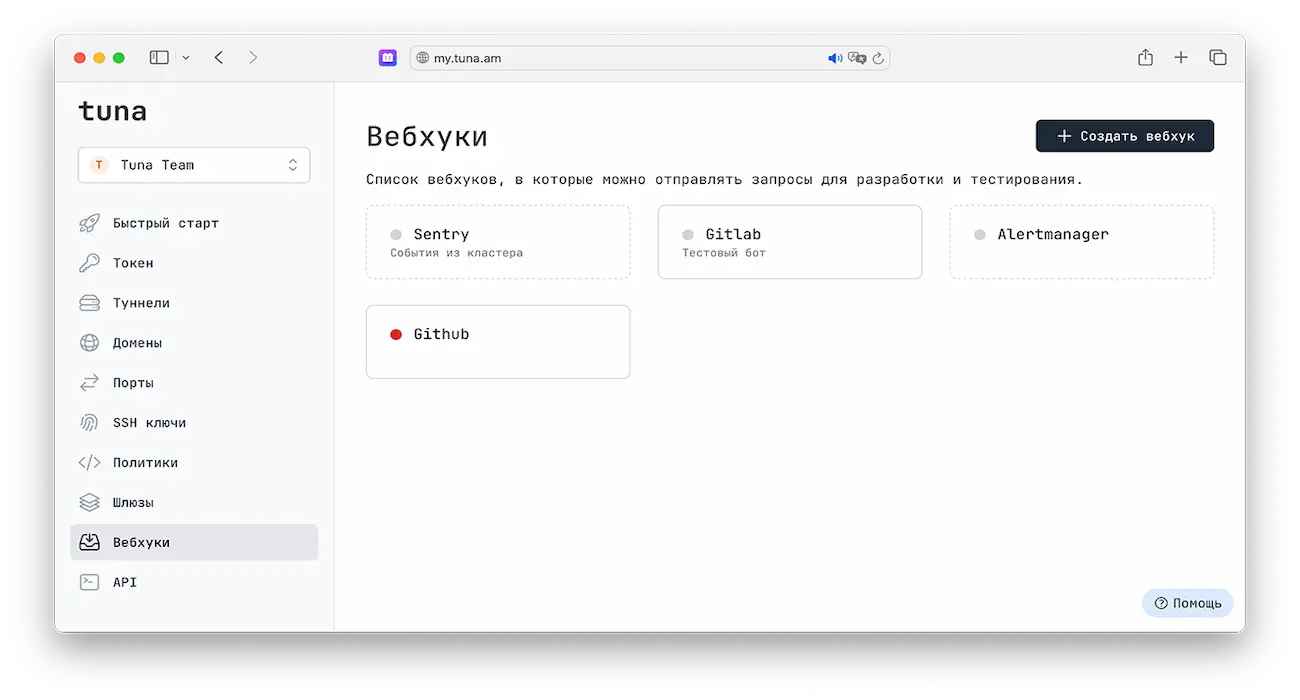
How to set up webhooks
- 1. Choose a service
- Choose the service you need to set up a webhook for. For example, webhooks can be configured for Telegram bots, GitHub webhooks, payment services and many others.
- 2. Assign an action
- You can create webhooks for specific or all actions — for example, opening a PR or push. You can use Tuna Webhooks to understand what exactly comes in the request body, what headers, etc.
- 3. Set response parameters
- You can edit the response, including: status code, Content-Type header and response body. The editing window can be accessed from the menu on the right, where there are also other options like link, clearing history or deletion.
How does it work?
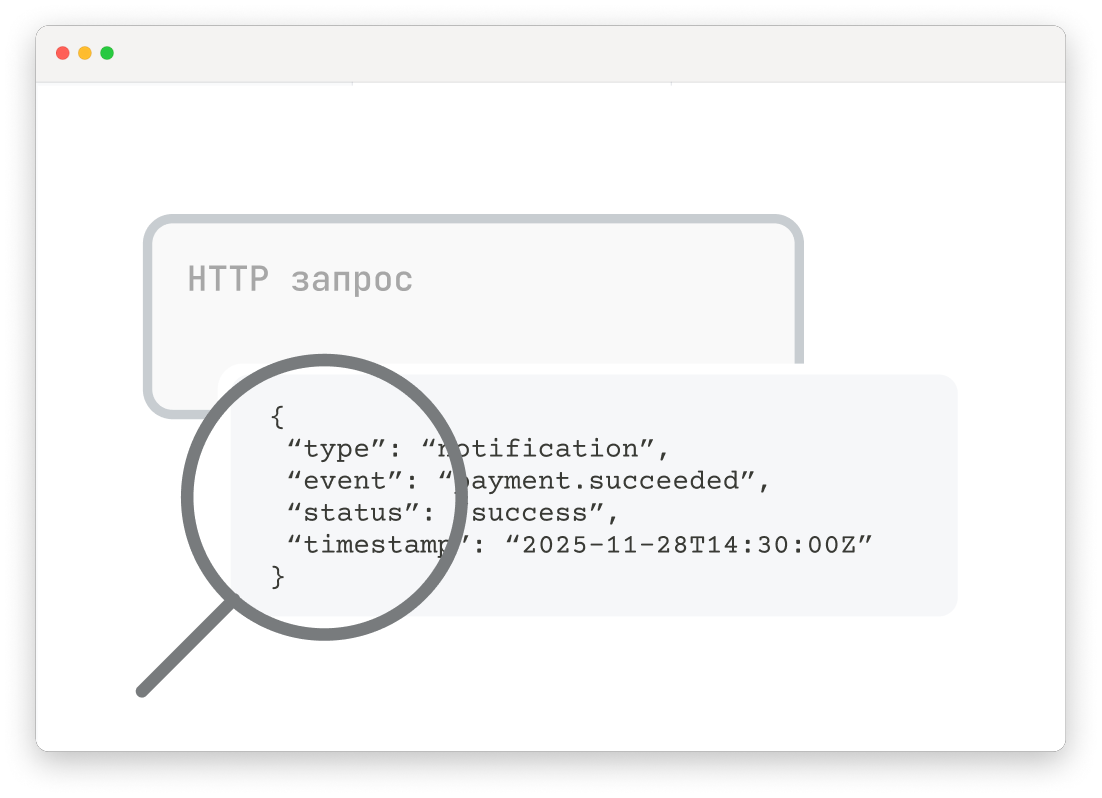
A service that sends notifications, whether it's Stripe, GitHub, Telegram or any other, sends an HTTP request to the URL of your webhook in Tuna.
We save all information about the request: headers, body, source IP and so on.
You can view all information in a convenient interface, as well as change the response that will be sent back to the service, and forward the request to your tunnel.
Webhooks Reviews
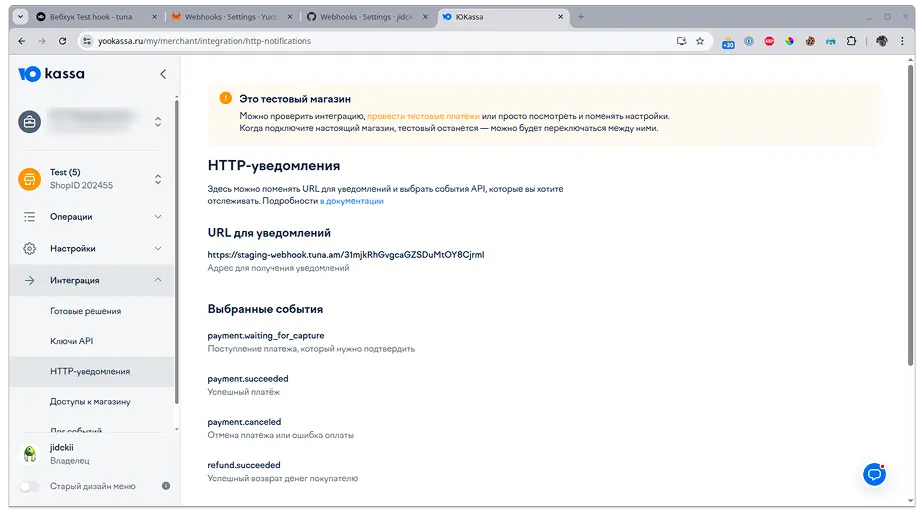
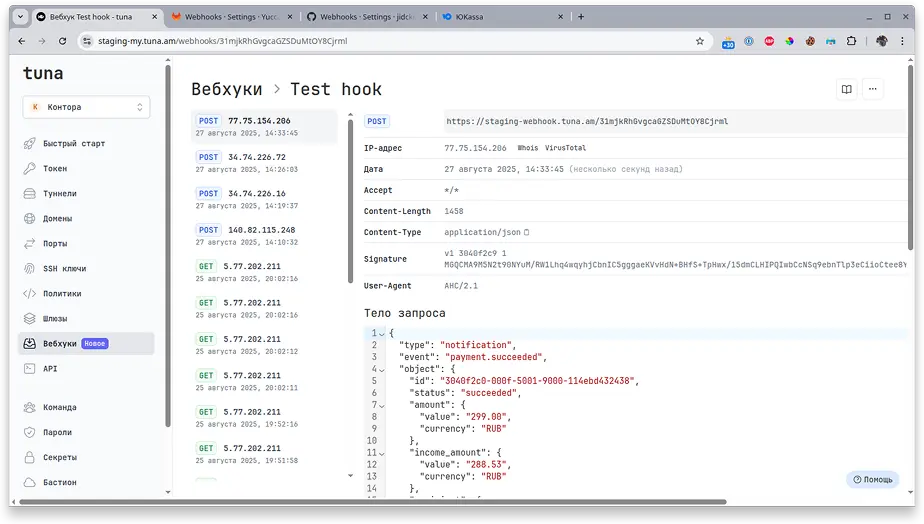
Example webhook for debugging YooKassa http notification:
Imagine you have a test store and you want to understand what exactly comes in the HTTP notification when paying for an order.
Specify the URL of your webhook in the store notification settings, create an order and pay for it, on the webhook page you will see a new notification and can view its body, headers and other information.
But that's not all! You can mock the response using traffic policies, for example, return a 500 code, or redirect the request to your tunnel to your application.
 TUNA — platform for developers
TUNA
platform for developers
TUNA — platform for developers
TUNA
platform for developers
TUNA — platform for developers
TUNA
platform for developersPricing
Get 2 months free with annual subscription
 Beginner
- 1 HTTP tunnel
- 1 subdomain in tuna.free zone New
- Dynamic subdomains
- No time limit New
- 1 project
- 5 environments per project
- 5 configs per environment
- 1 webhook
- 1 project
- 7 days storage
- 1 monitor
- 1 board
- 10 participants
- 1 hour
Free
Install-
Pro
- 5 tunnels simultaneously
- 10 subdomains in tuna.am zone
- 1 static port
- 1 own domain
- No time limit
- All tunnel types
- 10 projects
- 10 environments per project
- 10 configs per environment
- 3 monitors (watch)
- 10 webhooks
- 1 project
- 30 days storage
- 10 monitors
- 10 boards
- 10 participants
- 6 hours
5 USD /month
50 USD /year
Buy  Legend
- 10 tunnels simultaneously
- 10 subdomains in tuna.am zone
- 10 own domain
- 5 static ports
- Own domain zones
- Traffic policies
- IP access policies
- 20 projects
- 20 environments per project
- 20 configs per environment
- 5 monitors (watch)
- 20 webhooks
- 20 projects
- Unlimited storage
- 20 monitors
- Integrations
- 20 boards
- 20 participants
- 12 hours
- 200 nodes per team i
10 USD /month
100 USD /year
Buy

What's included in the plan
- Traffic policies i
- IP access policies
- Own domain zones (wildcard)
- IP address hiding in dynamic subdomains
- 10 tunnels simultaneously
- 10 own domains
- 5 static ports
- No time limit
- HTTP tunnels
- TCP tunnels (RAW, SSHd, Postgres, Redis)
- SSHd tunnels (built-in SSH server)
- Trigger tunnels (Webhook or Email)
- Kubernetes tunnels (cluster access via kubectl)
- 1C tunnels (publishing 1C:Enterprise infobases)
- 10 subdomains in tuna.am zone
- Multiple regions
- Dynamic subdomains
- End-to-end encryption
- Let's Encrypt SSL/TLS certificates
- HTTP / Postgres / Redis requests inspector
- Basic authentication
- Access restrictions by IP/Api-Key/User-Agent
- Rate limiting
- CORS automation
- Websocket and Server-Sent Events (SSE) support
- Built-in file server
- WebDAV server
- Service creation management (background operation)
 +1 Additional license
$2 /month
+1 Additional license
$2 /month
- +1 active tunnel
- +1 subdomain in tuna.am zone
- +1 own domain
- +1 static port
What's included in the plan
- TCP tunnels (RAW, SSHd, Postgres, Redis)
- SSHd tunnels (built-in SSH server)
- Trigger tunnels (Webhook or Email)
- Kubernetes tunnels (cluster access via kubectl)
- 1C tunnels (publishing 1C:Enterprise infobases)
- No time limit
- 5 tunnels simultaneously
- 10 subdomains in tuna.am zone
- 1 static port
- 1 own domain
- HTTP tunnels
- HTTP / Postgres / Redis requests inspector
- Multiple regions
- Dynamic subdomains
- End-to-end encryption
- Let's Encrypt SSL/TLS certificates
- Basic authentication
- Access restrictions by IP/Api-Key/User-Agent
- Rate limiting
- CORS automation
- Websocket and Server-Sent Events (SSE) support
- Built-in file server
- WebDAV server
- Service creation management (background operation)
+1 Additional license
$1 /month
- +1 active tunnel
- +1 subdomain in tuna.am zone
- +1 own domain
- +1 static port
What's included in the plan
- Multiple regions
- 1 HTTP tunnel
- Dynamic subdomains
- 1 subdomain in tuna.free zone
- No time limit
- End-to-end encryption
- Let's Encrypt SSL/TLS certificates
- HTTP requests inspector
- Basic authentication
- Access restrictions by IP/Api-Key/User-Agent
- Rate limiting
- CORS automation
- Websocket and Server-Sent Events (SSE) support
- Built-in file server
- WebDAV server
- Service creation management (background operation)
What's included in the plan
- 1 project
- 5 environments per project
- 5 configs per environment
- Secrets generator
- Change history
- Secrets synchronization across environments
- Compare secret values across environments
- Hidden secrets
- IP address access
- Service keys for specific configuration access
What's included in the plan
- 10 projects
- 10 environments per project
- 10 configs per environment
- 3 monitors (watch)
- Automatic application restart on secret change (watch)
- Secrets generator
- Change history
- Secrets synchronization across environments
- Compare secret values across environments
- Hidden secrets
- IP address access
- Service keys for specific configuration access
What's included in the plan
- 20 projects
- 20 environments per project
- 20 configs per environment
- 5 monitors (watch)
- Automatic application restart on secret change (watch)
- Secrets generator
- Change history
- Secrets synchronization across environments
- Compare secret values across environments
- Hidden secrets
- IP address access
- Service keys for specific configuration access
What's included in the plan
- 1 board
- Drawing: shapes, lines, arrows
- Stickers and brainstorms
- Comments and chat on the board
- Timer for brainstorms and retros
- Presentation mode
- Export to JPG, PNG, PDF, SVG
What's included in the plan
- 10 boards
- Drawing: shapes, lines, arrows
- Stickers and brainstorms
- Comments and chat on the board
- Timer for brainstorms and retros
- Presentation mode
- Export to JPG, PNG, PDF, SVG
What's included in the plan
- Voice chat right in the board
- Real-time collaboration
- 20 boards
- Drawing: shapes, lines, arrows
- Stickers and brainstorms
- Comments and chat on the board
- Timer for brainstorms and retros
- Presentation mode
- Export to JPG, PNG, PDF, SVG
What's included in the plan
- Up to 10 participants in a meeting
- Meeting length up to 1 hour
- Team channels and link rooms
- Pre-call settings window
- Virtual backgrounds and blur
- Screen sharing
- In-call chat
- Calls from a phone
What's included in the plan
- Up to 10 participants in a meeting
- Meeting length up to 6 hours
- Team channels and link rooms
- Pre-call settings window
- Virtual backgrounds and blur
- Screen sharing
- In-call chat
- Calls from a phone
What's included in the plan
- Up to 20 participants in a meeting
- Meeting length up to 12 hours
- Team channels and link rooms
- Pre-call settings window
- Virtual backgrounds and blur
- Screen sharing
- In-call chat
- Calls from a phone
What's included in the plan
- 1 webhook
- View HTTP requests
- View Email
What's included in the plan
- 10 webhooks
- View HTTP requests
- View Email
What's included in the plan
- 20 webhooks
- View HTTP requests
- View Email
What's included in the plan
- Password storage using zero-knowledge model
- Secrets type separation
- TOTP support
- External sharing capability
What's included in the plan
- Password storage using zero-knowledge model
- Secrets type separation
- TOTP support
- External sharing capability
What's included in the plan
- Shared catalogs
- Password storage using zero-knowledge model
- Secrets type separation
- TOTP support
- External sharing capability
What's included in the plan
- 200 nodes per team i
- Zero-Trust SSH access to servers
- Mandatory (RBAC) access model
- Authentication using temporary RSA keys and PKI certificates
- Audit and observability (coming soon)
- SSO integration (coming soon)
What's included in the plan
- Traffic policies i
- Number of gateways is limited by the limit on static domains and subdomains in the tuna.am zone
What's included in the plan
- Role-based access control (RBAC)
- Event audit
- Invoice payment (RU)
What's included in the plan
- 1 project
- 7 days report storage
- Screen recording
- Browser console
- Network requests
- DOM snapshot
- Report comments
- Email notifications
What's included in the plan
- 30 days report storage
- 1 project
- Screen recording
- Browser console
- Network requests
- DOM snapshot
- Report comments
- Email notifications
What's included in the plan
- 20 projects
- Unlimited report storage
- Telegram notifications
- Slack notifications
- Discord notifications
- VK Teams notifications
- Google Chat notifications
- Webhook notifications
- Screen recording
- Browser console
- Network requests
- DOM snapshot
- Report comments
- Email notifications
What's included in the plan
- 1 monitor
- Job monitors
- Heartbeat monitors
- HTTP monitors
- TCP monitors
- DNS monitors
- ICMP (Ping) monitors
- Email notifications
What's included in the plan
- 10 monitors
- Job monitors
- Heartbeat monitors
- HTTP monitors
- TCP monitors
- DNS monitors
- ICMP (Ping) monitors
- Email notifications
What's included in the plan
- 20 monitors
- Telegram notifications
- Slack notifications
- Discord notifications
- VK Teams notifications
- Google Chat notifications
- Webhook notifications
- Job monitors
- Heartbeat monitors
- HTTP monitors
- TCP monitors
- DNS monitors
- ICMP (Ping) monitors
- Email notifications
 How to start?
Start with installing and initial setup of the client - it will take no more than a minute
 Frequently Asked Questions about Webhooks
Currently, Webhooks are available on all plans.
Yes, depending on the plan, there are limitations on the number of webhooks used.
Ways to work with Webhooks with examples are described in detail in the corresponding section of our documentation.
Still have questions? Email us at info@tuna.am .
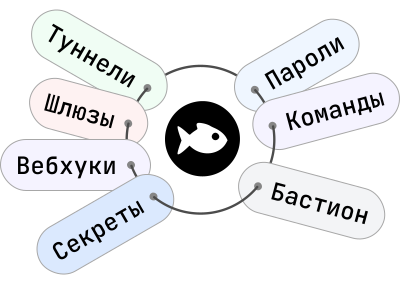
Unified platform for:
- accelerating development
- simplifying team collaboration
- improving security
- cost optimization
Tuna Desktop
A new way to manage tunnels without the console. Install on Windows, MacOS or Linux and get started in seconds.
Install