Team
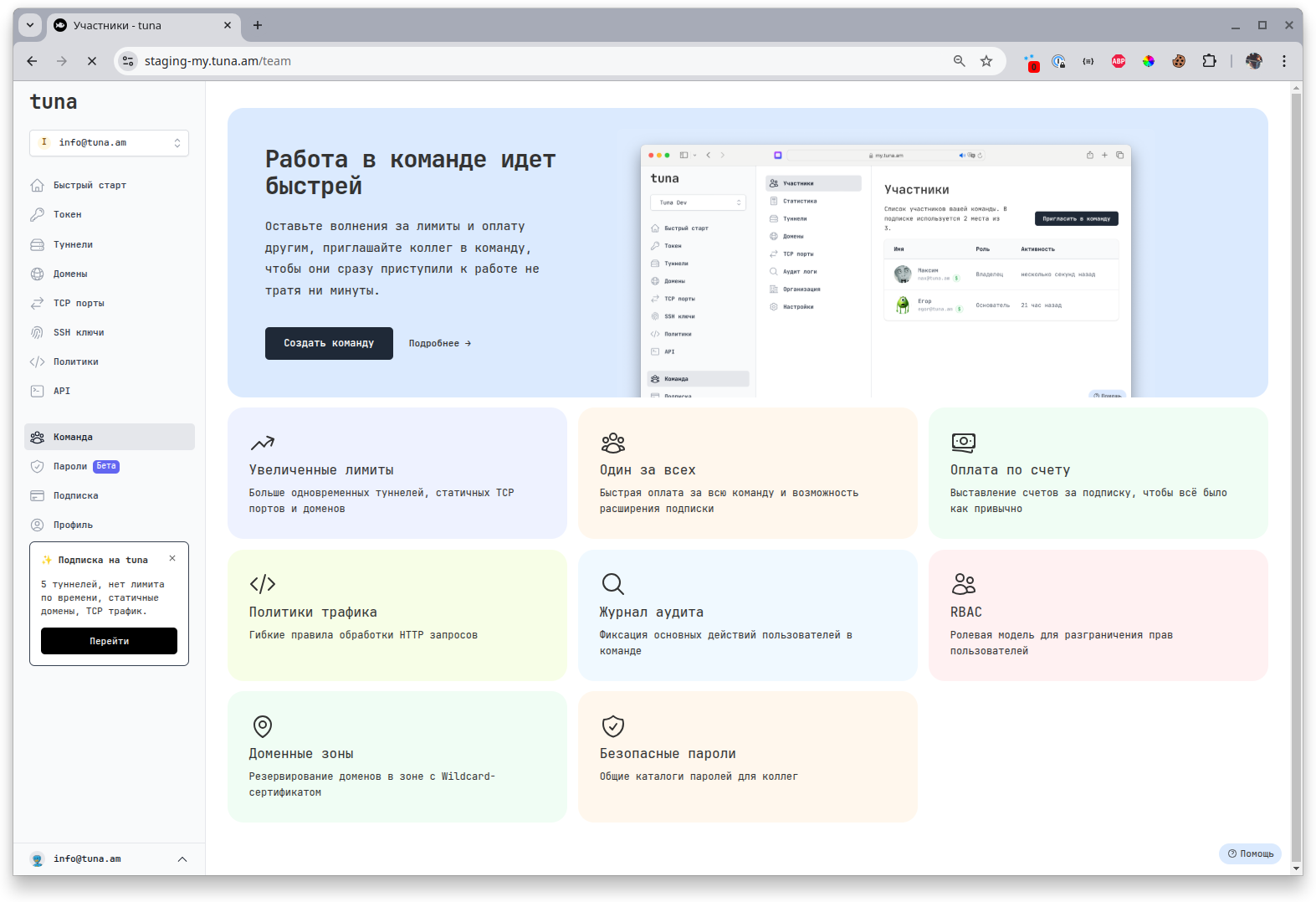
This section of the documentation describes the features and functions when working with Tuna in a team.
Overview
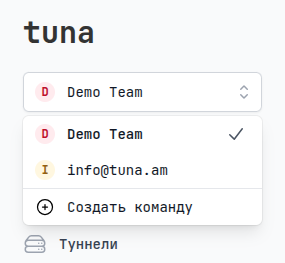
Each Tuna platform user can be a member of multiple teams, as a creator or participant. Switching between personal and team accounts is done using the selector in the upper left corner of the screen, where there is also a button to create a new team.
Who is this for?
We help companies and startups engaged in development, which often have distributed teams. With Tuna, you can significantly accelerate development and administration, simplifying interaction between participants without compromising security.
- publishing local environments
- transferring files directly to each other
- remote access to workstations and servers on private networks
- secure password transmission
- publishing Demo environments to customers
All this and many other use cases that you can come up with yourself will make your experience with Tuna exceptional.
Navigation
📄️ Members
Team member management, access roles
📄️ Roles
User access roles in the team
📄️ Интеграции
Настройка интеграций для отправки уведомлений в сторонние сервисы
📄️ Контакты
Группы контактов для отправки уведомлений от мониторов
📄️ Statistics
General quantitative indicators of resource usage in the team
📄️ Tunnels
List of active tunnels of all users in the team.
📄️ Domains
List of reserved domains of all users in the team.
📄️ TCP ports
List of reserved static TCP ports of all users in the team.
📄️ SSH keys
List of public SSH keys of all users in the team.
📄️ Domain zones
Managing custom domain zones (wildcard)
📄️ TLS certificates
Managing TLS certificates in the team
📄️ IP policies
Team-wide access policies for tunnels by subnets
📄️ Master keys
Managing members' password manager
📄️ Audit logs
Audit of team member actions
📄️ Organization
Payment by invoice for companies and sole proprietors
📄️ Settings
Managing basic team settings, security and more